 Image credit: ScienceDirect
Abstract
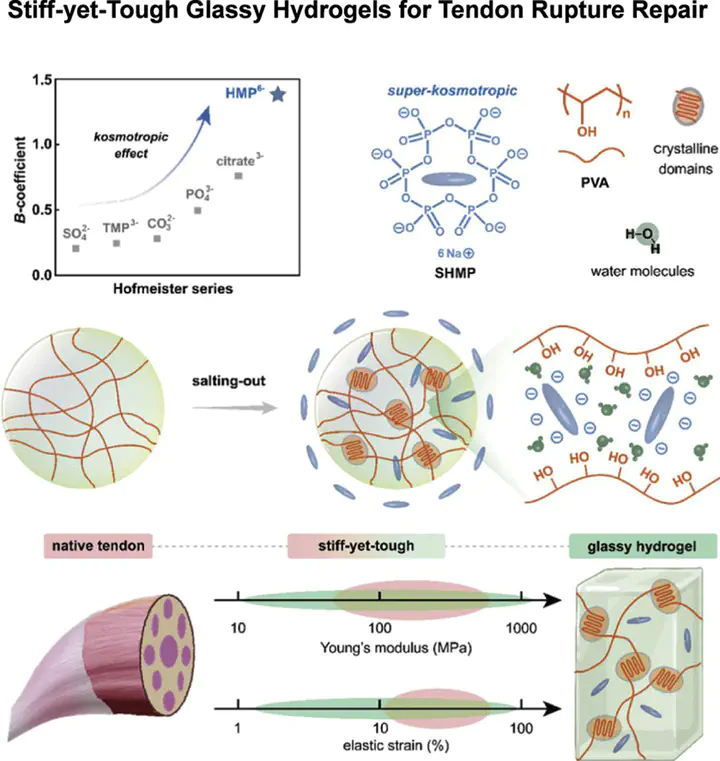
Natural load-bearing tissues such as tendon exhibit both high stiffness and toughness owing to their densely packed, hierarchical architectures. However, most synthetic hydrogels suffer from biomechanical mismatch and lack of biocompatibility, which restrict their utility in tendon-related therapy. In this work, we report a set of glassy, poly(vinyl alcohol) hydrogels, stiffened and toughened through salting-out with a super-kosmotropic salt, sodium hexametaphosphate. The highly-charged anion displays an exceptional B-coefficient of 1.408 L mol -1 with remarkable kosmotropic effect, which not only promotes the formation of crystalline domains but also immobilizes free water molecules within gel networks. The resultant materials are endowed with substantially enhanced stiffness, toughness and fracture energy of 1061.8 MPa, 548.5 MJ m -3, and 272.5 kJ m -2, respectively, matching those of native tendons. Utilizing these hydrogels as biomechanical scaffolds in a tendon-ruptured rat model demonstrate high efficacy in both morphological and functional recovery. Salting-out biopolymers with super-kosmotropic agents enlightens the design and construction of stiff-yet-tough biomaterials, holding great promise for biomedical applications in regenerative and reparative therapies of natural load-bearing tissues.