Zehuan Huang

Zehuan Huang

Principal Investigator

Peking University

Zehuan Huang is a Principal Investigator at Peking University, focusing on “precise construction and biomedical application of high-performance supramolecular biomaterials”. Research within the Zehuan Group are mainly delicated to exploiting dynamic and reversible molecular interactions to design and construct functional supramolecular gels/elastomers/plastics with controlled structures and comprehensive mechanical properties, thus serving biomedical applications in reparative and replacement therapy of soft tissues. Art is I, Science is We, we sincerely welcome enthusiastic, creative, and self-motivated individuals to join us!

Interests
  • Supramolecular materials science
  • Biomedical engineering of soft tissues
  • High-performance dynamic polymers
Education & Experience
  • Principal Investigator, 2023-

    Peking University, School of Materials Science and Engineering

  • Marie-Curie Postdoctoral Fellow, 2018-2022

    University of Cambridge, Yusuf Hamied Department of Chemistry, Advised by Prof. Oren A. Scherman

  • PhD in Chemistry, 2013-2018

    Tsinghua University, Department of Chemistry, Supervised by Prof. Xi Zhang

  • BSc in Chemistry, 2009-2013

    Tsinghua University, Department of Chemistry

Highlights

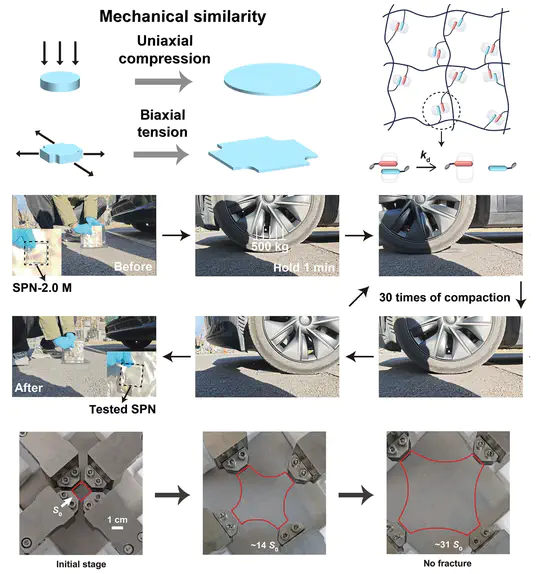
Biaxially ductile supramolecular polymer networks
Squeezable and 2D-stretchy ‘Super-jelly’:Supramolecular polymer networks are endowed with both enhanced compressibility and biaxial stretchability. Sci. Adv. (2026)
Biaxially ductile supramolecular polymer networks
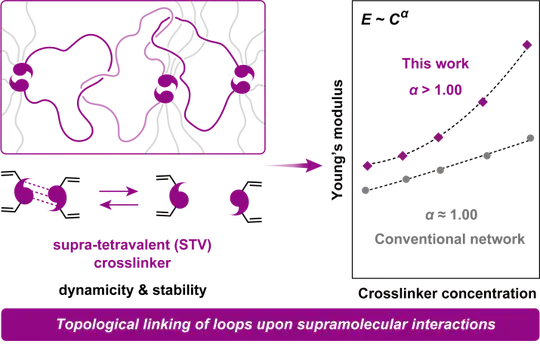
Stiffness Reinforcement in Polymer Networks Through Supramolecular Topological Linking
Supramolecular topological linking enables polymer networks that are simultaneously stiff and ductile, displaying exceptional stiffness scaling behavior. Angew. Chem. Int. Ed. (2026)
Stiffness Reinforcement in Polymer Networks Through Supramolecular Topological Linking
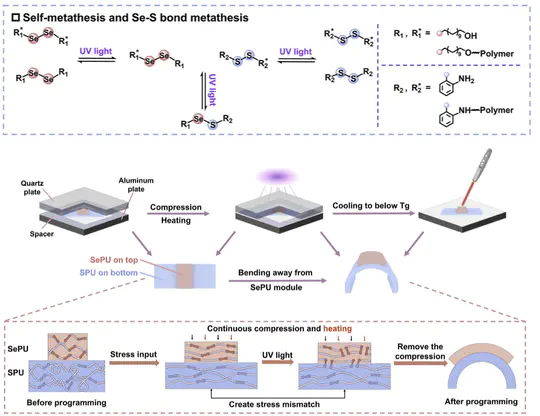
Ultrafast Programming of Large Curvature Based on Selenium-Sulfur Dynamic Metathesis
Se-S Metathesis: Dynamic selenium-sulfur bond exchange enables ultrafast large-curvature programming of polymer origami with enhanced mechanical performance and scalable 3D assembly. Adv. Mater. (2026)
Ultrafast Programming of Large Curvature Based on Selenium-Sulfur Dynamic Metathesis
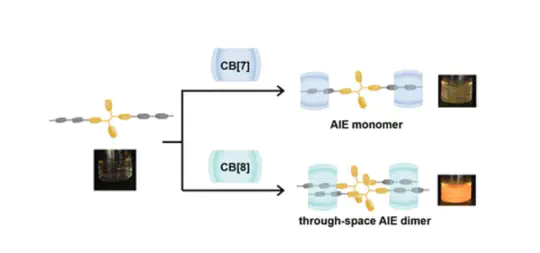
How many fluorophores are required to achieve AIE?
Two is enough:An archetypal AIE fluorophore together with cucurbit[n]uril macrocyclic hosts enables the controlled formation of discrete dimers, shedding light onto the early stages of aggregation. Chem. Sci. (2025)
How many fluorophores are required to achieve AIE?
Kinetic Locking of pH-Sensitive Complexes for Mechanically Responsive Polymer Networks
pH-driven kinetic locking: designed guest molecules modulate ion-dipole interactions with the hosts, resulting in mechanical switch of dynamicity within polymer networks. J. Am. Chem. Soc. (2025)
Kinetic Locking of pH-Sensitive Complexes for Mechanically Responsive Polymer Networks
Supramolecular Switching of Liquid-Liquid Phase Separation for Orchestrating Enzyme Kinetics
Nap-o-Nap: a molecule, designed to undergo supramolecularly-regulated liquid-liquid phase separation (LLPS), enabling quantitative analysis of molecular interactions within LLPS and providing a platform to modulate enzyme kinetics through selective client recruitment and exclusion by resultant coacervates Angew. Chem. Int. Ed. (2025)
Supramolecular Switching of Liquid-Liquid Phase Separation for Orchestrating Enzyme Kinetics